











































































Your cart
There are no more items in your cart

October is a chance to refocus on regular eye tests, up-to-date prescriptions and the quality of your glasses in everyday life
We tend to notice our eyesight most when something changes. Text seems further away, using the computer requires an unnatural posture, your glasses slip down your nose, or reading in the evening becomes less effortless. Eye Health Month reminds us that we don’t need to wait for obvious discomfort to start paying attention to our eyesight.
In Italy, an ophthalmologist is the medical professional to consult for eye health, diagnosis and prescriptions. Isolani’s work begins there: taking the prescription and turning it into a precise optical design, tailored to the individual’s specific distances, frame choice and actual habits.
Would you like to take a moment to check your vision? See the free visual check-up at Isolani Optical Centres and choose an appointment. An optical check-up does not replace an eye examination by an ophthalmologist.
A month to take stock, without any ready-made solutions
World Sight Day is observed every year on the second Thursday in October. It is an international opportunity to raise awareness of the importance of access to eye care and services. However, it is not a quick fix: an occasional check-up or a quick test does not replace an examination by an ophthalmologist.
The most useful thing you can do is simple: check when your last eye test was and, if necessary, consult your ophthalmologist. With an up-to-date prescription, the process of having your glasses made can begin on a sound footing.
The restart changes the distances covered during the day
Between September and October, routines that had often been put on hold resume: hours spent at the computer, travelling, driving, meetings, reading and evening activities. We use our vision at different distances throughout the day, and not everyone goes about their day in the same way.
For those who need to see from a distance, at intermediate distances and up close, the guide to progressive lenses and the fitting method explains why prescription, frame and lens alignment must be designed as a single system.
To help you choose between varifocal, office and photochromic lenses, our Isolani multifocal eyewear guide It brings together methodology, testing and quality assurance in a single guide.
Work, screens and office lenses
Anyone who spends many hours looking at screens, documents and people in the room may need a wider field of vision for near and intermediate distances. In such cases, it is not simply a matter of applying a one-size-fits-all solution, but of taking into account the workstation, the distance from the screen, posture and any glasses already being worn.
The guide Glasses for work and screen use It helps you distinguish between progressive lenses, office lenses and solutions for digital use, whilst maintaining realistic expectations.
And for the little ones, the return to school continues even after September
School, homework, sport and leisure activities put the stability of the frames and the quality of vision to the test every day. October is a good time to check how well your child’s glasses fit and whether their daily routines are balanced.
In our Back to School: Eyewear, School and Children’s Eyesight We have compiled practical advice on fit, digital features, checks and adjustments for glasses.
For an overview of frames, lenses, customer service and programmes designed to support your development, please also see our HUB on children’s glasses.
From prescription to spectacles: where the result is created
A technologically advanced lens does not function in isolation. The shape and stability of the frame, as well as its height, angle and distance from the face, all affect the point through which the wearer looks. This is why aesthetic considerations and optical design must go hand in hand.
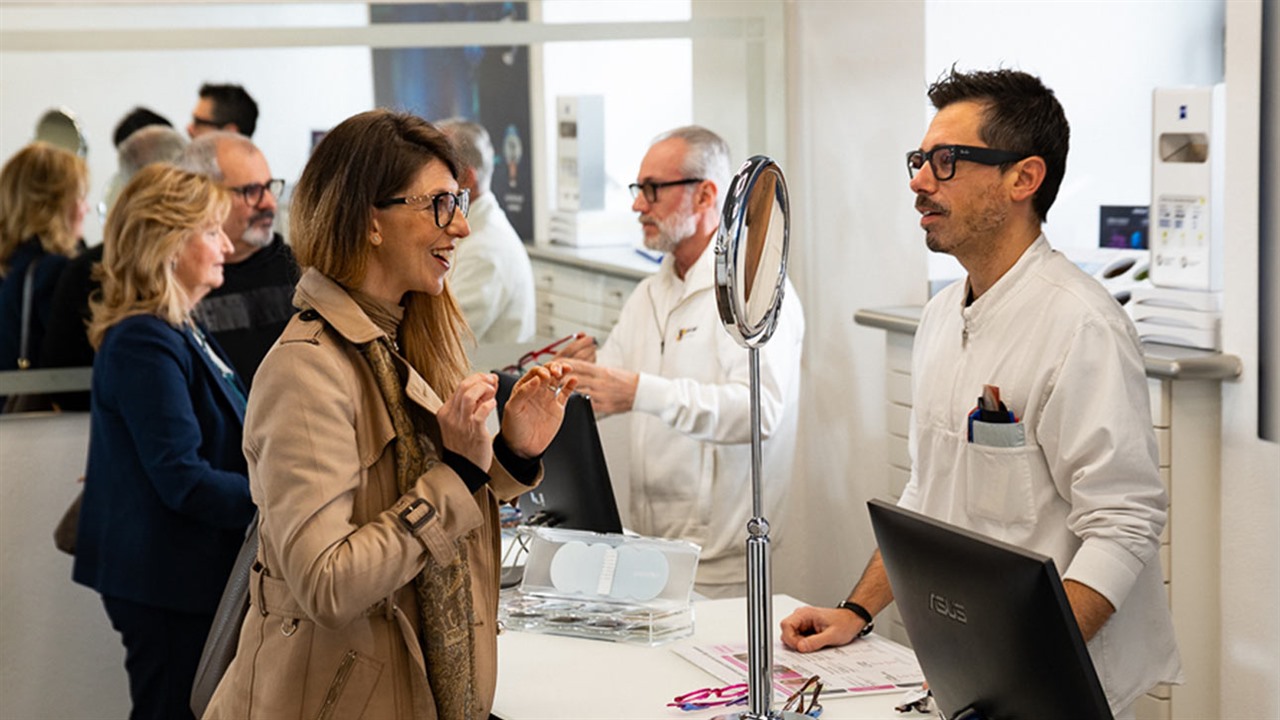
In theIsolani Experience™ Let’s combine listening, Behavioural Alignment, try it in the Simulation Room, assembly in our workshops and after-sales support.
It’s also a good idea to have your current pair of glasses checked
You don’t always need to change your glasses. Sometimes it’s enough to restore the correct fit, adjust the temples and nose pads, check the screws and end pieces, or check the condition of the lenses. A well-fitting pair of glasses is more likely to stay in the position intended by the design.
You can pop into one of our Isolani Opticians With your glasses: we’ll check the fit and make any technical adjustments free of charge, and, where possible, we’ll also sort out minor everyday mishaps at no extra cost.
Frequently Asked Questions
Does a check-up at an optician’s replace an eye examination?
No. The ophthalmologist is the specialist for eye health, diagnosis and prescribing. The optician’s carries out the prescription and handles the design, measurements, manufacture, fitting and aftercare of the spectacles.
Is October a good time to have your glasses checked?
Yes. As we return to work, school and our daily routines, it becomes clearer whether your frames, lenses and the distances at which you use them are still suited to your needs.
Do people who work at a computer always need office lenses?
No. It depends on the distances involved, the hours of use, your posture and the glasses you are already wearing. Your choice should be based on your actual working environment.
Is the frame adjustment free of charge?
Yes. At Isolani Optical Centres, fit checks and technical adjustments are free of charge; wherever possible, we also carry out repairs free of charge for minor everyday mishaps.
The information on this page is provided for information purposes only and relates to the optical and commercial sectors. It does not contain any medical, clinical or diagnostic content.