































































Your cart
There are no more items in your cart

Best times in Liguria and across Italy, suitable sunglasses and mistakes to avoid when observing the Sun – don’t just wing it
Wednesday 12 August 2026, shortly before sunset, a partial solar eclipse will be visible from Italy. Liguria will be among the best places to view it: in the western part of the region, up to around 95 per cent of the Sun’s disc may be obscured, provided the sky is clear and the horizon is completely unobstructed towards the west-north-west.
The spectacle will be particularly striking precisely because the Sun will appear very low in the sky. However, the sunset does not guarantee safe viewing: even when only part of the solar disc remains visible, looking directly at it without specific protection exposes your eyes to an avoidable risk.
Expert Isolani advises: prepare in advance; don’t leave it to the last minute
To watch the eclipse directly, you will need specialist sunglasses or sun goggles that comply with the requirements of standard EN ISO 12312-2:2015, purchased from a reputable manufacturer or retailer. Before use, check that the device bears the manufacturer’s details, instructions and warnings, and that the filter is intact: if it is scratched, torn, punctured or detached from its holder, do not use it.
Ordinary sunglasses, even very dark or polarised ones, are designed for a different purpose and do not allow you to look directly at the Sun. The same applies to tinted glass, photographic film, X-rays, CDs, ski goggles and handmade filters.
Why inadequate protection can damage your eyesight
Looking directly at the Sun without adequate protection can damage the retina, the light-sensitive tissue at the back of the eye. Such exposure can cause what is known as solar retinopathy, with possible symptoms including blurred vision, dark spots in the central field of vision or difficulty perceiving colours. These symptoms may also develop in the hours following exposure and, in the most serious cases, can lead to permanent damage. If changes in vision occur following accidental exposure, you should consult an ophthalmologist without delay.
The eclipse of 12 August 2026 in Liguria: times and where to watch it
In Liguria, the first contact is scheduled for between 19:29 and 19:31. The most intense phase is expected to occur at around 20:22 and 20:24, when the Sun will be very close to the horizon. In Genoa, Savona and La Spezia, calculations indicate that it will begin at around 7.29 pm and reach its peak at around 8.22 pm; in the Imperia area, the times are shifted by about one or two minutes.
These times describe the astronomical phenomenon; they do not guarantee that the Sun will be visible from the chosen location. A headland, a building, a hill or sea mist may obscure it before it reaches its peak. It is advisable to look for a stretch of coastline, a terrace or high ground with an unobstructed view towards west-north-west and observe the sunset from the same spot on the previous days.
Two events to look out for in Liguria
- Riomaggiore Castle (SP), from 7.30 pm: Eclipse observation and live broadcast by INAF-UAI-PLANit, organised by the Digital Astronomy Group.
- Shrine of Our Lady of Soviore, Monterosso al Mare (SP), from 6.00 pm: A presentation and guided observation session using a telescope and specialised binoculars, organised by the Spezzini Amateur Astronomers’ Association.
Are you looking for an appointment elsewhere in Italy? EduINAF collects and updates information on events reported from across the country: before you set off, check theNational list of events for the eclipse, as programmes and access arrangements are subject to change.
And what about Genoa? At the time of publication, no official events have yet been announced. To check for any updates, follow the official website of the Righi Astronomical Observatory, UAI Regional Delegation.
Where and when will it be visible in the rest of Italy?
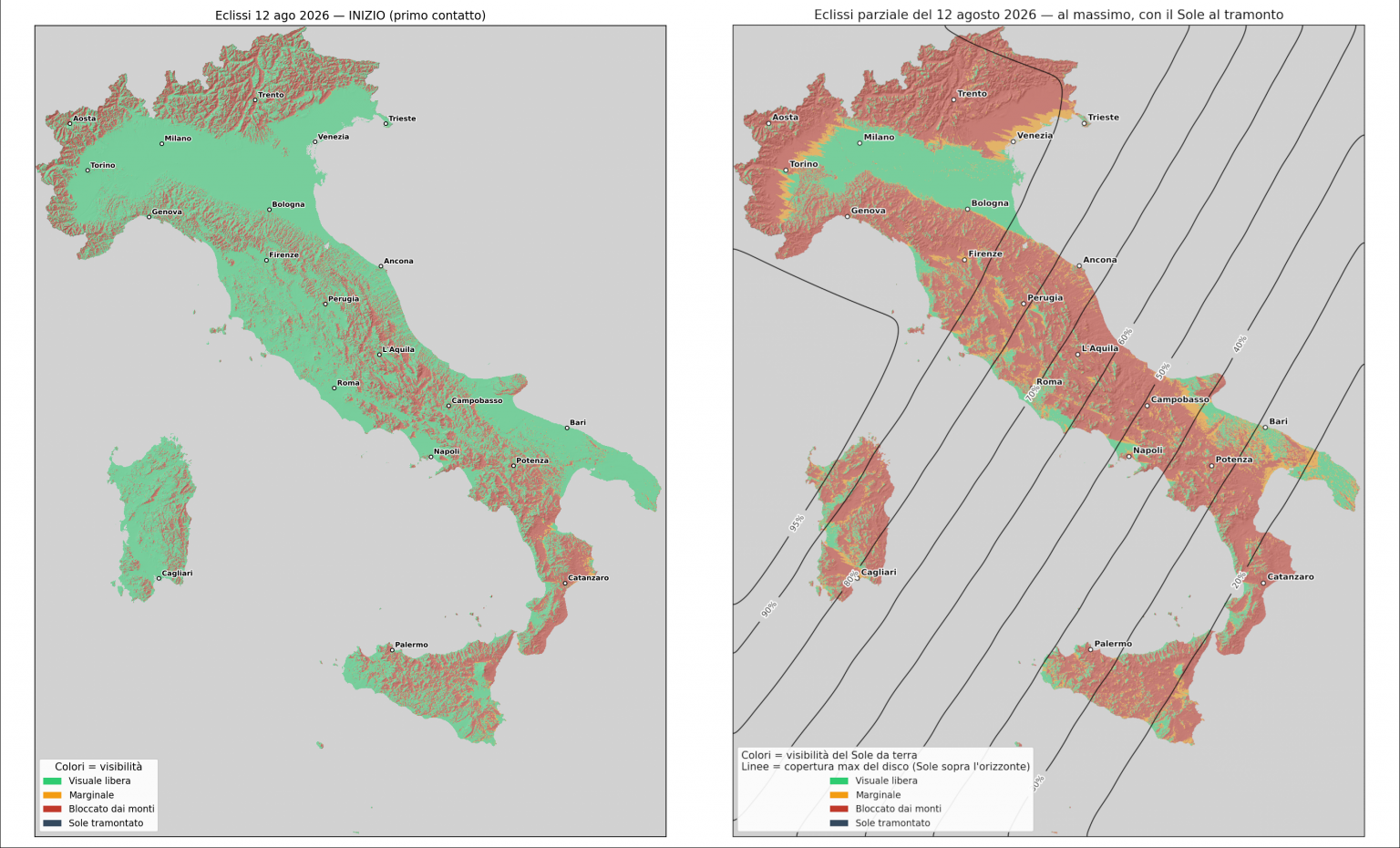
The eclipse will begin at around 19:30 across much of the country. The areas set to experience the best viewing conditions will be Piedmont, the Aosta Valley, Liguria, Lombardy, Emilia-Romagna, Tuscany and Sardinia, where the expected eclipse coverage could reach or exceed 90 per cent. Moving towards central and southern Italy, the coverage will decrease and, in many places, the maximum eclipse will occur after the Sun has already set.
The actual horizon is therefore more important than the name of the town. The INAF maps also take the terrain into account and help to distinguish between places with an unobstructed view and those where the Sun will be hidden. If the weather or the landscape prevents observation, the INAF-UAI-PLANit live stream It will start at 7.30 pm.
Eclipse glasses: what you really need to check
The ISO mark alone is not sufficient to guarantee the quality of the product: it may also be printed on devices that have not been tested. It is wiser to choose headsets from reputable manufacturers, accompanied by instructions and a declaration of conformity with the requirements of the EN ISO 12312-2:2015, with tests carried out by an accredited laboratory.
Before putting them on, hold the filter up to the light without pointing it towards the Sun. There must be no holes, cracks, deep scratches or areas where the filter has come away from the frame. The glasses must cover both eyes properly and stay securely in place. Children must be checked and supervised by an adult at all times.
If you have any doubts about the origin of the device or the information printed on it, don’t take any chances. You can ask for a comparison at one of our Isolani Opticians.
How to use the headset without exposing yourself unnecessarily
- Check the filter before observing and follow the manufacturer’s instructions.
- Put on your goggles, or hold the visor up to your eyes, first to turn towards the Sun.
- Look at it for short periods and look away if the device moves or does not cover your eyes properly.
- Turn back in the opposite direction before removing the protective cover.
- Never use the solar filters in conjunction with binoculars, telescopes or cameras pointed at the Sun.
A camera, a pair of binoculars or a telescope focus light: they require specific solar filters to be fitted in front of the camera and advice from an expert. The small visor in front of the eyes does not protect against the concentrated beam and must not be used as a filter for instruments.
Smartphones and photographs: the screen does not provide protection
Capturing the eclipse on your phone does not automatically make it safe to view. Avoid staring at the Sun whilst framing the shot, and never look through optical viewfinders. Cameras and smartphones may also require specialised protection for the sensor and lens: night mode, dark glass or makeshift filters are no substitute for a solar filter designed specifically for that device.
Sunglasses and eclipse glasses are not the same thing
A good pair of sunglasses protects against UV radiation and improves comfort in normal lighting conditions; a solar viewer for direct observation must reduce the light to vastly lower levels. They are two different instruments, governed by different requirements. In our A guide to UV protection and choosing sunglasses Let’s explain the role of sunglasses in everyday life: however, they should never be confused with a device for looking at the Sun.
Sources and updates
Opening times, visibility and safety information have been checked against the resources of theNational Institute of Astrophysics, on the NASA guidelines for observing eclipses and in accordance with the guidelines set out in theAmerican Astronomical Society to test solar filters. Local times are approximate and may be obscured by terrain, buildings, mist or clouds.
Frequently Asked Questions about the eclipse on 12 August 2026
Are polarised sunglasses enough for watching the eclipse?
No. Even very dark or polarised sunglasses are not suitable for looking directly at the Sun. You need special solar viewing glasses that comply with the requirements of EN ISO 12312-2:2015.
What time does the eclipse start in Liguria?
The first sighting is expected to take place between approximately 19:29 and 19:31; the most intense phase will occur between 20:22 and 20:24. Actual visibility will depend on the horizon to the west-north-west and on the weather.
Can you take off your eclipse glasses during a partial eclipse?
No. From Italy, the eclipse will remain partial, and a bright part of the Sun will always be visible. When observing the eclipse directly, you must wear appropriate eye protection throughout the entire event.
Can I take photos of the eclipse with my smartphone?
You must not look directly at the Sun whilst framing your shot. Smartphones and cameras may require specific filters to protect the sensor and lens; tinted glass and makeshift solutions are not suitable.
Can children watch the eclipse?
Yes, provided you are wearing suitable, undamaged sunglasses correctly, and always under the constant supervision of an adult. An event led by qualified staff provides a more controlled environment.
Would you like to find out more? Discover all the articles on eye health in Isolani Magazine.
The information on this page is provided for information purposes only and relates to the optical and commercial sectors. It does not contain any medical, clinical or diagnostic content.