








































































Your cart
There are no more items in your cart

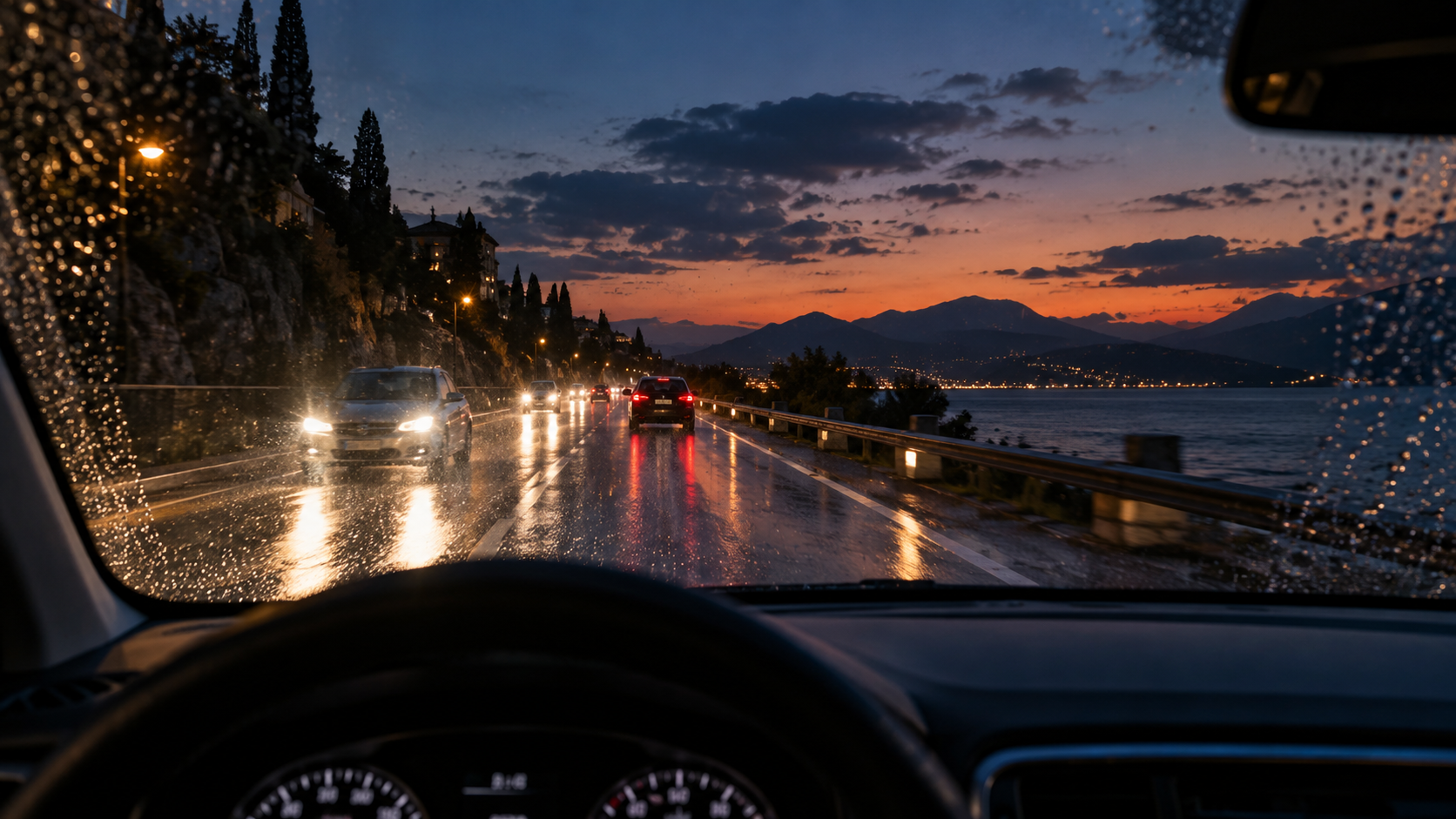
Headlamps, rain and wet tarmac can make driving in the evening more challenging. Before looking for a ‘miracle’ lens, it’s worth understanding the root cause of the problem and checking your spectacles, prescription, cleanliness and the actual conditions in which you use them.
Why every glare seems stronger at night
In the dark, the scene contains less information and light sources become more prominent. Headlamps, signs, street lighting and reflections on the windscreen can obscure the details we’re trying to make out. If it’s raining, the wet surface multiplies the points of light and makes it harder to naturally make out lanes, road signs and distances.
It is not always down to a single cause. An out-of-date prescription, a scratched lens, a frame that has shifted out of place or a dirty windscreen can all combine to make things more difficult.
Before checking your lenses: four simple checks
Clean glasses: Smudges and fingerprints scatter light precisely when contrast is at its most subtle.
Stable frames: If your glasses slip down or tilt, you’re no longer looking through the area intended by the prescription.
Up-to-date prescription: A prescription that is no longer suitable can make details, road signs and light sources appear less sharp.
Windscreen and headlights: Cleanliness, condensation and the adjustment of the vehicle’s lighting do not depend on the glasses, but they do affect the quality of the view.
The ACI recommends paying particular attention to night-time visibility, the cleanliness of lighting systems and the correct use of full-beam and dipped-beam headlights. Glasses are therefore part of the system, not the only factor.
What a good anti-reflective coating can do
An anti-reflective coating reduces reflections on the lens surfaces and allows more useful light to pass through. When driving in the evening, it can make vision clearer and more comfortable, especially when there are numerous light sources. However, it must be applied to a correctly fitted lens that is well-centred and kept in good condition.
Not all coatings are the same, and simply reading a marketing description is not enough. The material, geometry, quality of the coating, prescription and frame must all work together.
Many manufacturers group some of these solutions under names such as Drive, DriveSafe or similar designations. These are different product ranges, not a single standard: behind the name, the lens geometry, anti-reflective coating, contrast management and any selective filter may vary. To compare them, you therefore need to look at what the lens actually does and what it is designed for.
The right question is not ‘which lens is best for night-time driving?’
It is: what bothers me, when does it happen, and which aspect of my spectacles or driving conditions can we actually improve?
It is: what bothers me, when does it happen, and which aspect of my spectacles or driving conditions can we actually improve?
Selective yellow filters, dark lenses and polarised lenses: they are not the same thing
During the day, polarised lenses can be very useful against horizontal glare from roads and shiny surfaces. At night, however, the priority is not to unnecessarily reduce the available light: a dark lens is not suitable.
What are simply called ‘yellow-tinted lenses’ are not necessarily a colour chosen at random. There are selective filters designed to attenuate certain components of light and enhance the perception of contrast. They can come in different shades and intensities – for example, a very light version and a more pronounced one – without this making them ordinary sunglasses.
In conditions of diffused light, such as fog, overcast skies or rain, some customers may find this increase in contrast useful. At twilight and in the dark, however, the available light is already reduced: the filter, its intensity, colour perception and actual benefit must be assessed on a case-by-case basis, taking into account the individual and the situation in which they are used. It is not a one-size-fits-all solution, and the same filter may be comfortable for one person but unsuitable for another.
Progressive lenses and night-time driving
With progressive lenses, it is important that the frame remains in the intended position and that the centration is consistent with the wearer’s personal way of looking. The road, dashboard, mirrors and sat-nav involve different distances and directions: our Isolani Multifocal Pathway was created specifically to design and test this combination, using simulation and ensuring a good fit.
Photochromic lenses respond to ambient light, but in a car their behaviour may differ from that observed outdoors. Here too, the choice must be based on actual use.
When it’s worth having a check-up
If the discomfort has only recently appeared, if one eye seems to behave differently from the other, or if the difficulty remains significant even with clean, properly fitted glasses, trying to sort it out yourself won’t help. At Isolani Optical Centres, we can check your prescription, lens alignment, lens condition and fit as part of an optical and optometric assessment. Should any issues arise that require further medical investigation, we advise the customer to consult an ophthalmologist.
Frequently asked questions about night-time driving
Does an anti-reflective coating eliminate glare from headlights?
No. It can reduce reflections from the lens surface and improve comfort, but it does not eliminate all sources of glare on the road.
What does ‘Drive lens’ mean?
It is generally a trade name used for lenses designed with driving in mind. It does not refer to a standardised technology across all brands: features and performance must be checked on a product-by-product basis.
Do yellow lenses improve night-time vision?
They are not a one-size-fits-all solution. They can alter the perception of contrast, but the choice must take into account the available light, the prescription and the actual driving conditions.
Are polarised lenses used at night?
Polarised lenses are primarily designed to control glare in daylight conditions. At night, it is important not to unnecessarily reduce the available light.
Why do I see more glare when it’s raining?
A wet road reflects headlights and street lighting, creating more bright spots in your field of vision. Keeping your glasses and windscreen clean, ensuring your prescription is up to date and using the right lens treatment can help reduce avoidable distractions.
Can an optician’s check the glasses I’m already wearing?
Yes. We can check the fit, adjustment, condition of the lenses, centring and prescription from an optical and optometric perspective. Technical adjustments to the frames are free of charge.
Sources consulted: ACI – Driving behaviour; ZEISS Vision Care – night vision; ZEISS Vision Care – yellow filters and contrast. Accessed on 29 September 2026.
The information on this page is for information purposes only and relates to the field of optics and optometry. It does not contain medical diagnoses or advice and is not a substitute for a visit to an optometrist or for road safety regulations.