









































































Your cart
There are no more items in your cart

From braking manoeuvres to reflexes and peripheral vision: the unseen work of the gaze in Formula 1
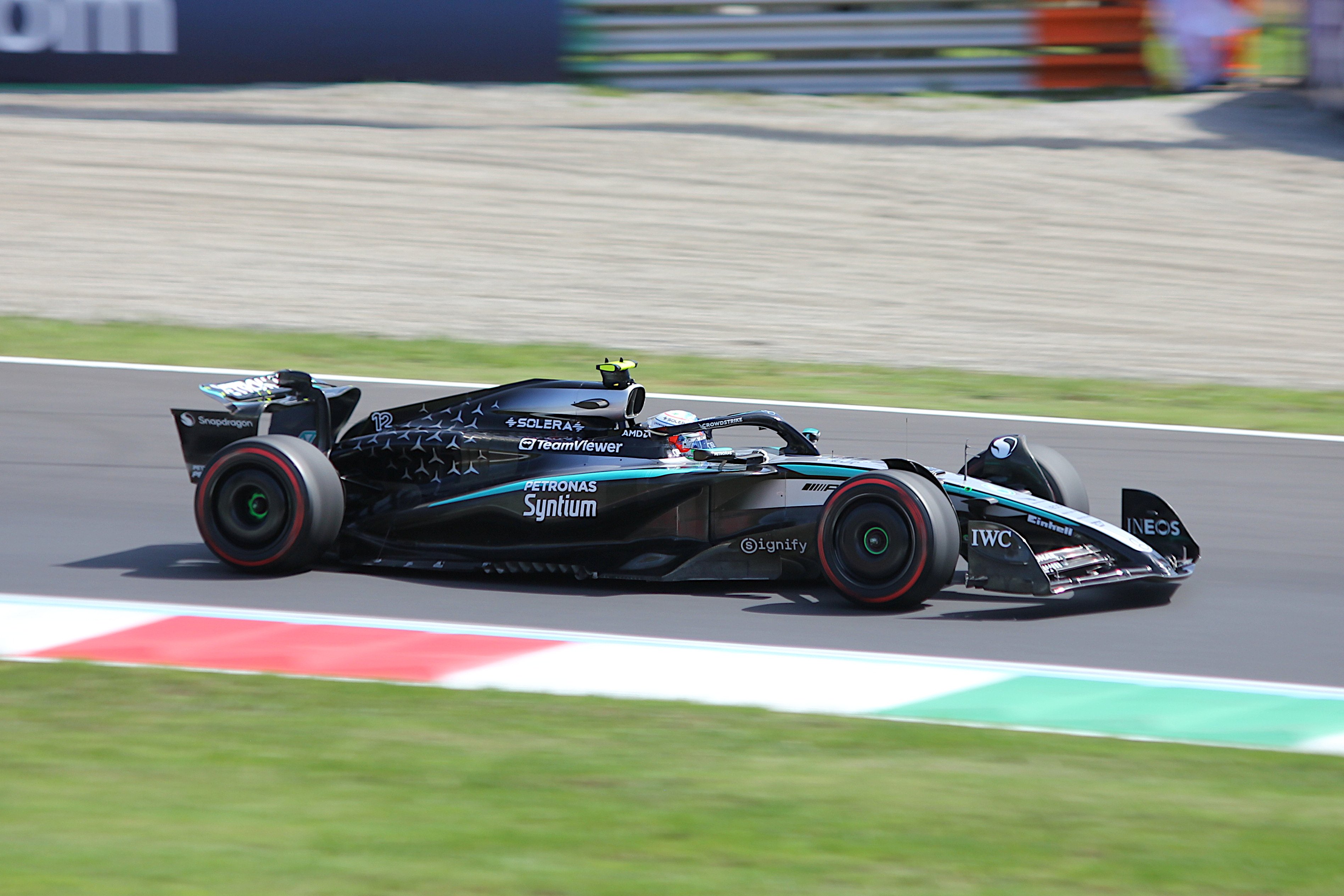
On the cover: Andrea Kimi Antonelli, Italian driver, during free practice for the 2025 Italian Grand Prix at Monza. Photo by Eustace Bagge / Wikimedia Commons, CC BY 4.0 licence. Image unedited, adapted to fit the cover layout.
At Monza, speed isn’t just something you watch: you have to read it. Even before the crowd hears the brakes, the driver has already spotted the reference point on the tarmac, assessed the position of the other cars and prepared his gaze for the exit from the corner. On the circuit that celebrates speed more than any other, vision is a precision tool.
The 2026 Italian Grand Prix takes place from 4 to 6 September. The circuit measures 5.793 kilometres and the race consists of 53 laps. But the statistic that truly captures the essence of Monza is another: according to Formula 1, at the Variante del Rettifilo, the cars decelerate from around 350 km/h to 70 km/h. In that very brief interval, the driver cannot react to what he sees: he must know where to look before the decisive moment arrives.
4–6 September: 2026 race weekend
5.793 km circuit length
53 laps – race distance
350 → 70 km/h at the first chicane
Seeing at 350 km/h does not mean seeing everything
From home, it seems as though a driver observes the track ahead of him just as we do when driving. In reality, his gaze works ahead of the action: it seeks out the braking point, shifts towards the kerb, prepares for the apex and then the exit. Meanwhile, peripheral vision continues to take in what’s happening at the sides: an approaching single-seater, a light signal, a movement in the wing mirror.
It’s a fascinating balance between detail and the bigger picture. The point of focus must be precise, but concentrating too narrowly would mean missing everything that’s moving around. Monza makes this process even more evident because it alternates long stretches at very high speed with very intense braking and tight chicanes.
The track doesn’t simply become ‘blurred’. The brain selects familiar reference points, direction and movement. Experience and training allow the driver to direct their gaze to the right place at the right time: the speed remains extreme, but the reading of the circuit is prepared in advance.
The helmet protects; the visor must allow the track to be read
Normal sunglasses are not used during the race: it is the helmet visor that shields the eyes from the air, debris and light. FIA guidelines state that the visor must provide a clear, unobstructed view; darker visors may be useful in sunny conditions, but are unsuitable for night-time racing. Here too, there is no one-size-fits-all solution: visibility and light conditions must remain consistent.
This principle also applies outside professional motorsport. You shouldn’t choose a lens simply because it’s dark or looks sporty: what matters is UV protection, optical quality, contrast, frame stability and the actual environment in which they’ll be used.
For those watching the Grand Prix live: sun, shade and glare
Watching Monza from the grandstands is very different from watching it on television. You move from full sun to shade, the tarmac reflects the light, and your gaze shifts between the track, the big screens and the areas closest to you. A good pair of sunglasses must, first and foremost, be certified, comfortable and stable: a lens that is simply very dark is not synonymous with protection.
Polarised lenses can reduce some glare from surfaces such as the tarmac, but before choosing them, it’s worth checking how they work with your smartphone or any other screens you’ll be using during the day. To understand this technology better, you can read the guide to polarised lenses and the entries on reflection, glare and contrast in the Isolani Optical Glossary.
In the stands
Certified UV protection, a secure fit and a tint that suits your personal light conditions and sensitivity are more important than an overly technical look.
For everyday sport
A wraparound frame can help protect against sun, wind and glare; however, the shape and lenses should be chosen based on the activity, not just on aesthetics.
Prescription sports glasses or contact lenses?
When vision correction is required, some sports glasses can be fitted with prescription lenses. Whether this is feasible depends on the frame, the prescription strength and the type of activity. During sport, however, contact lenses often offer the greatest freedom: they remain stable during movement and provide a wider field of vision than prescription glasses.
The most practical combination might be a correctly fitted contact lens, with a non-prescription sports pair of glasses worn over the top to protect against the sun, reduce glare and, depending on the sport, also shield against wind and dust. This is not a choice to be made on the spur of the moment by simply copying the specifications of your glasses: fitting, wear times and lens type must be assessed by a professional. You can find out more about the Isolani method on the page dedicated to Advanced Contact Lens Practice.
To explore designs, technologies and solutions tailored to sport, you’ll also find our guide to sports glasses.
Monza reminds us that vision is behaviour
The driver does not use their gaze in a static way: they shift it, anticipate, select and coordinate it with their movements. It is an extreme version of something that happens every day. Driving, running, cycling or watching a match all require different distances, postures and lighting conditions.
This is why a well-chosen pair of sports glasses isn’t the result of a one-size-fits-all formula. It starts with the actual activity, the light conditions encountered and the way the frame sits on the face. At 350 km/h, every detail becomes spectacular; in everyday life, the same principles translate into comfort, stability and naturalness.
Source for calendar and circuit data: official Formula 1 website – 2026 Italian Grand Prix, accessed on 26 August 2026. For the visor: FIA Competitor Safety Equipment Guidelines.
Frequently asked questions about the Monza Grand Prix and viewing
How fast do Formula 1 cars go at Monza?
The speed varies throughout the lap. Formula 1 states that, at the Variante del Rettifilo, the cars brake from around 350 km/h down to around 70 km/h. It is therefore neither a constant speed nor a record attributed to a single car.
Do drivers wear sunglasses during the race?
During the race, protection and light management are provided by the helmet visor, not by ordinary sunglasses. The visor must maintain a clear field of vision appropriate to the environmental conditions.
Are polarised lenses useful for watching the Grand Prix from the grandstands?
They can help reduce certain reflections, such as those from the tarmac. However, it is advisable to check the readability of smartphones and displays, as some screens may appear darker at certain angles.
Can sports glasses be made with a prescription?
In many cases, yes, but it depends on the frame, the prescription and the activity. For some sports, you might also consider combining contact lenses with non-prescription sports glasses.
When will the 2026 Italian Grand Prix take place?
The official programme is scheduled for 4 to 6 September 2026, with the race taking place on Sunday 6 September. Timetables and updates should always be checked on the official Formula 1 website.
The information on this page is provided for information purposes only and relates to the optical and commercial sectors. It does not contain any medical, clinical or diagnostic content.