






































































Your cart
There are no more items in your cart

Children’s glasses don’t just sit in front of the mirror: they go through lessons, runs, games, sports and little unexpected incidents. To really work, they need to be comfortable, stay in place and become a natural part of the day.
When a child chooses a pair of glasses, colour matters. And rightly so: if they feel the glasses are their own, they’ll be more willing to wear them. But for us, the real choice begins just a few minutes later, when they stop looking at themselves in the mirror and go back to moving about as they always do.
That’s when we check whether the front frame sags, whether the temples are tight enough, whether the bridge sits comfortably and whether your line of sight remains in the correct area of the lenses. A pair of glasses that looks good but is unstable ends up having to be straightened with a finger a hundred times a day; a well-designed pair stays in place almost without you noticing.
At school, the distance between people’s gazes is constantly changing
The blackboard, the teacher, the exercise book, the textbook, the classmate: school isn’t just about ‘one fixed distance’. Glasses must support these activities without becoming a hindrance, even when the child stands up, runs about at break time or stuffs everything into their rucksack in a matter of seconds.
This is why fit and stability have a visual significance, not just an aesthetic one. If the frames slip, the position of the lenses in front of the eyes changes too. Our in-depth feature Back to School: explore, discover and create It sets out the checks and precautions to take before setting off again.
The right frame isn’t just a small one
A child’s face is not simply a smaller version of an adult’s. The bridge of the nose, proportions, the height of the ears and the way the child moves all require shapes and features that are genuinely designed for their age. Even two children in the same class may have very different needs.
- The bridge It must rest evenly, without allowing the front panel to slip.
- The rods and terminals They must provide support without being too tight and without creating pressure points.
- The gauge It must be proportionate to the face and consistent with the lenses that will be made.
- The weight It must be assessed in the context of the complete pair of spectacles: the frame and lenses work together.
- The child’s approval It’s part of the project, because the right pair of glasses is only of any use if they’re actually worn.
Our Guide to spectacle sizes It provides an initial guide, but the real test remains decisive when it comes to children.
Play and sport: endurance is important, but stability is key
During movement, a frame that is too rigid may transmit the impact more directly, whilst a flexible frame can absorb it more effectively. This does not mean that there are any indestructible glasses or ones capable of eliminating all risk: it means choosing materials, designs and components that are suited to the child’s activities.
Swissflex is one of the examples we use most often when lightness, flexibility and a very precise fit are required. The Kids system is modular, with no screws or metal components in the front or in the connections, and features selectable nose pads and temple tips. The frame weighs around 3 grams without the lenses, but the most important factor is how it sits on the face: it must be fitted and adjusted to suit the child, not simply chosen on the basis of a photograph.
For sporting activities, the solution always depends on the context. Where prescribed by an optician, contact lenses can also offer stability and a wider field of vision; for outdoor sports, they can be worn in combination with suitable non-prescription sports glasses, which help protect against the sun, glare and wind. The use of contact lenses in children always requires a prescription and monitoring by an optometrist, as well as a careful technical assessment.
From the optician’s prescription to the design of the glasses
The choice of lenses is based on the optician’s prescription. Our job is to turn this into a pair of glasses that are precise, durable and suited to the child’s everyday life: we select the material, shape, coatings and lens thicknesses to suit the frame and the way the glasses will actually be used.
Let’s apply the Behavioural Alignment This also applies to children’s spectacles, not just to lenses designed to manage the progression of myopia. Measuring the parameters with the frame in its natural position allows the lenses to be tailored to the way that particular child looks and moves.
If the prescription relates to progressive myopia, the treatment plan requires specific care and coordinated check-ups. In our HUB on developmental myopia in children We explain the role of the available technologies and, above all, the distinction between medical prescription and technical implementation.
Children’s glasses need to be adjusted as the child grows
The temples can become loose, the front section can lose its shape, and your face changes more quickly than you might think. A good pair of glasses does not stay a perfect fit forever simply because it was the right fit on the day you collected them: they need to be checked, cleaned and given minor adjustments.
There’s no need to wait for a scheduled service: you can pop into one of our Isolani Opticians whenever your glasses slip, feel too tight or lose their shape. We’ll check the fit free of charge, examine the nose pads, temples and stability, and adjust them as needed.
If a minor unexpected event occurs in everyday life, in our in-house laboratory We try to repair the glasses free of charge whenever the repair work allows. For more important occasions, the Isolani Service Charter with Mini-Kasko: support designed to ensure that families feel looked after even after their purchase.
The best choice is the one the child forgets to wear
A child shouldn’t have to spend the day worrying about their glasses. They should be able to read, run, draw and play whilst the frames stay securely in place and the lenses function as intended. This is where prescription, technology and everyday freedom come together.
In the Isolani Experience Parents and children are involved in the decision: we listen to their needs, assess the fit and develop a solution that works both on the face and in real life. For a complete overview, you can start with our A HUB dedicated to children’s glasses.
Frequently Asked Questions about children’s glasses
How can you tell if a pair of frames fits properly?
It must remain stable whilst the child is talking and moving, provide support without causing pressure points, and keep the lenses in the correct position. If the frame keeps slipping, leaves visible marks or the arms feel too tight, it needs to be checked.
Is it better to go for a lightweight frame or a sturdy one?
These two qualities must go hand in hand. The weight must be considered in relation to the complete pair of glasses, whilst the durability must be appropriate for the wearer’s age and lifestyle. No frame is indestructible.
Why is alignment important for children too?
This is because the position of the frame and individual parameters affect the way the lenses sit in front of the eyes. Centring allows the design to be tailored to the actual fit.
Can Swissflex children’s glasses be bought online?
At our Centri Isolani branches, we do not offer these for online purchase: the system needs to be fitted and adjusted directly on the face, selecting the components, shape and size to suit the child and the lenses.
How often should the fit be checked?
Whenever your glasses slip, feel too tight or look out of alignment – and in any case, from time to time, because your face changes shape and daily wear can alter their fit. You can pop into any of our Centri Isolani branches whenever you need to: routine adjustments are free of charge.
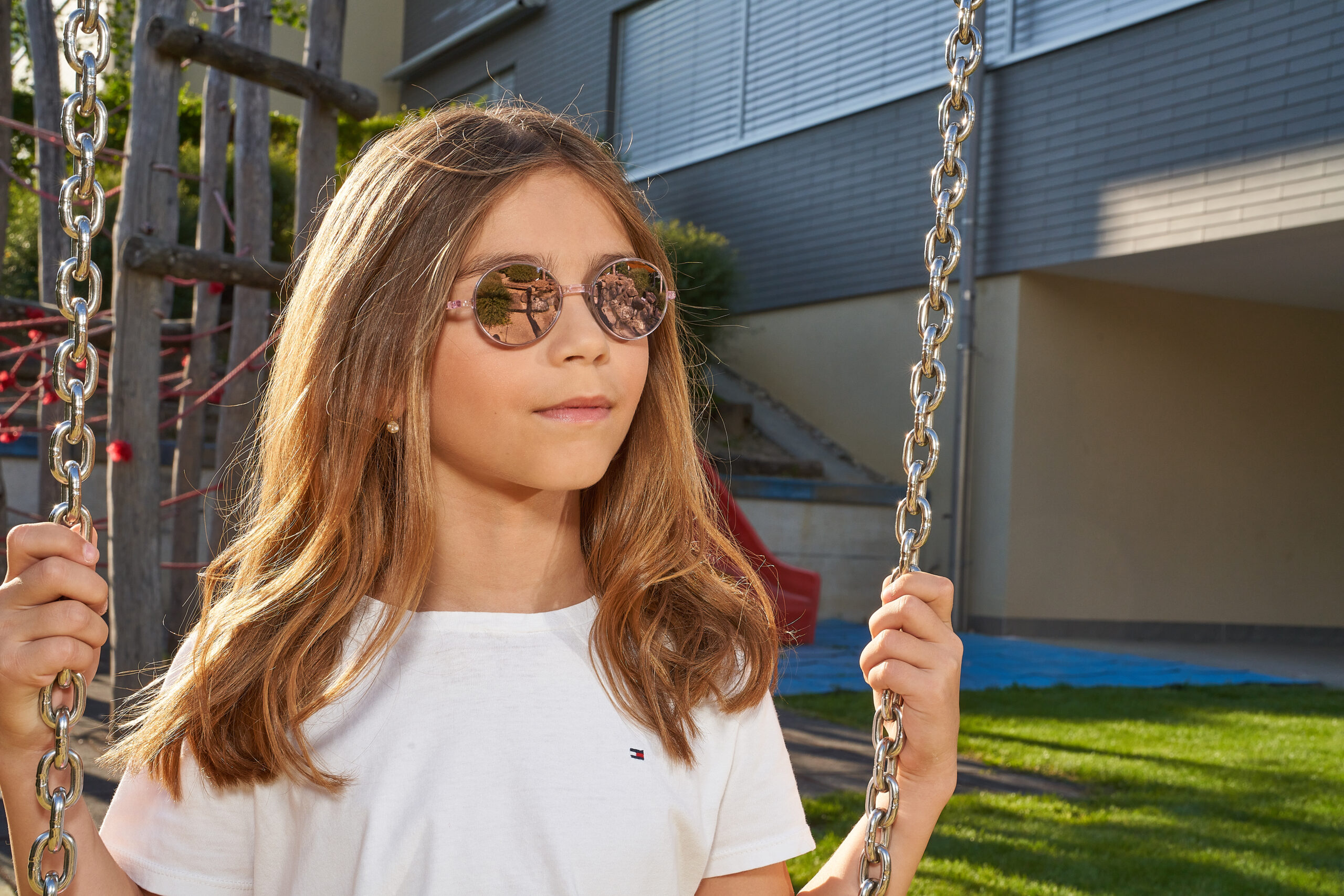
Cover image: Swissflex Kids, official image from the manufacturer. Source: Swissflex Kids.
The information on this page is provided for information purposes only and relates to the optical and commercial sectors. It does not contain any medical, clinical or diagnostic content.